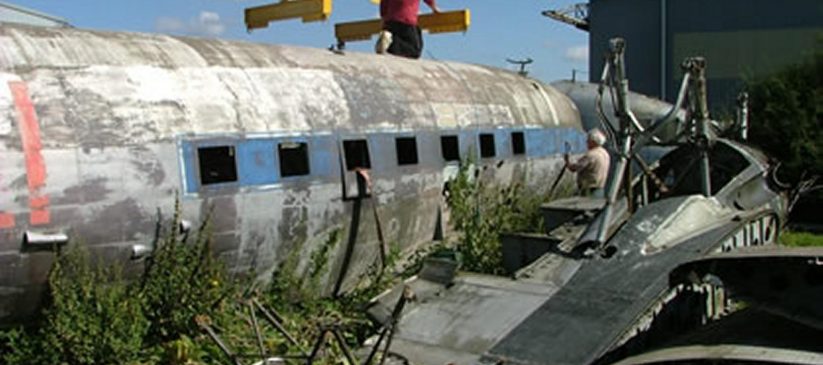
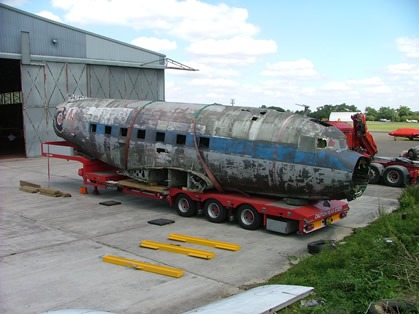
The rescue and relocation of the fuselage of C-47 Serial No. 43-49240 (RAF Serial FL586) was by road to the Wings Museum during late Summer 2007.
43-49240 saw service in the India-China theatre in WW2.
After the war it moved to Europe and was transferred to the Belgian Air Force (as K-1, radio call sign O-CWA) in 1946.
During 1952 it was re-registered to OO-SMA and a year later OT-CWA.
It saw service in the Congo from 1954 to 1960.
In Dec 73 it had reached the end of its usefulness and was stored at Koksijde.
In 2000 it was located at Schaffen-Diest (small airfield in Belgium) and during 2001 it was transported to North Weald in Essex, to participate in “Sword of Honour” where 43-49240 was used to represent a crash landing.
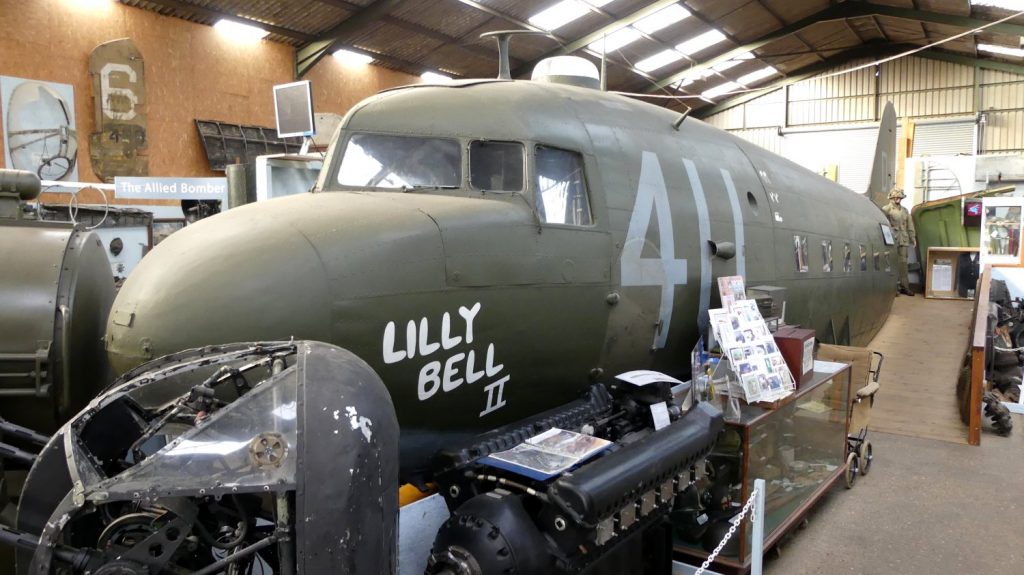
The museum has also obtained the forward cockpit section of C-47 42-100611 which was used for the filming of Band of Brothers, and it has now been mated onto the rear fuselage of 43-49240 to create a visitors’ walk-through experience.
The fuselage stands testament to all those air crews who were shot down during the D-Day operations of 6th June 1944.
42-100611 also saw service during World War Two, but with her wartime service log being ‘missing’ it has been hard to track down her exact operational history and any help to throw some light on her wartime history and/or photographs would be gratefully appreciated.
The salvage from North Weald (2007)
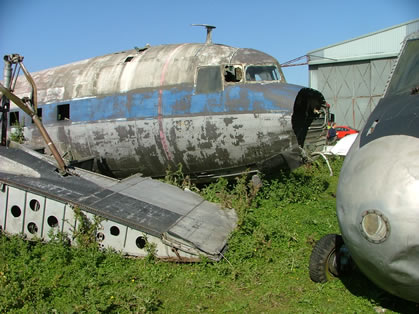
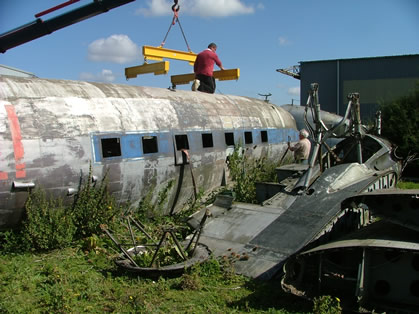
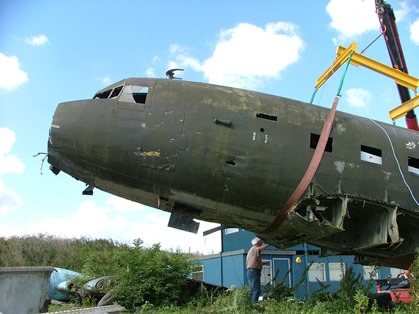
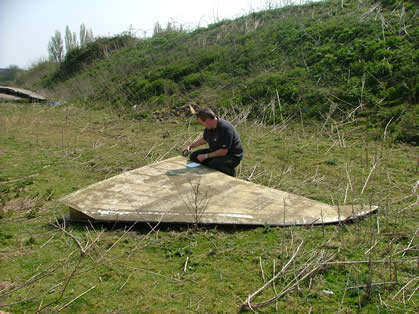
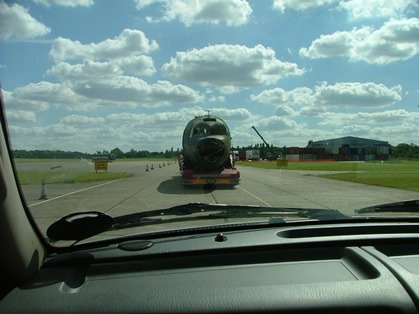
C-47 Fuselage Restoration (2009)
Following careful consideration by the museum, only the rear fuselage section of 43-49240 was used in the restoration of the Wings Museum’s C-47 walk through experience. The cockpit was carefully cut and sold off to recoup some of the recovery and transport costs involved in the salvage operation from North Weald. This has since found a home with a private collector in France.
The fuselage of 43-49240 had suffered over the years with the cockpit being completely gutted and set fire to for the filming of “Sword of Honor”, the museum therefore decided that the cockpit of 42-100611 would be an ideal substitute as the cockpit was fully “kitted out” to wartime spec.
Over a 12 month period a lot of work was undertaken by Wings Museum volunteers to create a complete C-47 fuselage, this included a lot of corrosion repair and preservation work to the mid-section, a new floor was fitted and the fuselage received a coat of new paint inside and out.
The C-47 has been repainted to represent “Lilly Bell II” which was a well known D-Day veteran. Lilly Bell II ended her service career crashing near Guildford tragically killing her crew. This display is presented in honour of the crew and to all those who lost their lives flying the C-47 during “Operation Overlord”.
Visitors can now experience what it would have been like to be a paratrooper on D-Day, and is proving very popular with school children and our younger visitors.
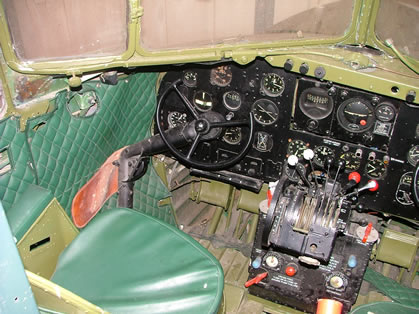
DC3 / C-47 ‘Dakota’ operational history
- Type Military transport aircraft
- Manufacturer Douglas Aircraft Company
- Designed by Douglas Aircraft
- Developed from Douglas DC-3
- Number built >10,000
- Produced 1949-1955
- Primary users U.S. Army Air Force, US Air Force, Royal Air Force
- Variants Lisunov Li-2, AC-47 Spooky
The C-47 was vital to the success of many Allied campaigns, in particular those at Guadalcanal and in the jungles of New Guinea and Burma where the C-47 (and its naval version, the R4D) alone made it possible for Allied troops to counter the mobility of the light-travelling Japanese army.
Additionally, C-47s were used to airlift supplies to the embattled American forces during the Battle of Bastogne.
But possibly its most influential role in military aviation was flying The Hump from India into China where the expertise gained would later be used in the Berlin Airlift in which the C-47 would also play its part.
In Europe, the C-47 and a specialized paratroop variant, the C-53 Skytrooper, were used in vast numbers in the later stages of the war, particularly to tow gliders and drop paratroopers during the D-Day Landings.
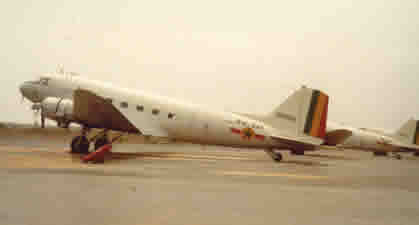
C-47s in British and Commonwealth service took the name Dakota. The C-47 also earned the nickname Gooney Bird in the European theatre of operations.
The USAF Strategic Air Command had C-47 Skytrains in service from 1946 to 1947.
After World War II the U.S. Navy also structurally modified a number of the early Navy R4D aircraft and re-designated the modified aircraft as R4D-8.
The C-47 was used by the Americans in the initial stages of the Berlin Airlift and was subsequently replaced by the C-54.
The Air Force also continued to use the C-47 for various roles, including the AC-47 gunships – codenamed Puff the Magic Dragon or Spooky – and the EC-47 for counterintelligence during the Vietnam War.
The Royal Canadian Air Force also adopted the C-47 for use in search and rescue operations throughout the 1940s and 50s.
Also rescued from North Weald was a C-119 Cockpit